
BIOFUELS
COMPUTER CONTROLLED BIOETHANOL PROCESS UNIT
.png) The Computer Controlled Bioethanol Process Unit ,EBEC, has been designed to study and control the bioethanol production process on a laboratory scale. This unit allows to monitor and examine all the important processes, from liquefaction and saccharification of the raw materials, to the conversion of sugar into ethanol and distillation.
The Computer Controlled Bioethanol Process Unit ,EBEC, has been designed to study and control the bioethanol production process on a laboratory scale. This unit allows to monitor and examine all the important processes, from liquefaction and saccharification of the raw materials, to the conversion of sugar into ethanol and distillation.
The unit consists of three main components: a mash tank, a fermentation tank and a distillation unit.
All vessels, valves and other accessories in contact with the process materials (except the distillation unit) are made of stainless steel. The distillation unit is made of borosilicate glass. Sight glasses are made of Neoceram glass.
The mash tank includes an inlet at its upper cover for filling water, starch and enzymes. Its base is slightly inclined towards a port for draining the solution or pumping it into the fermentation tank. During the mashing process the starch of the raw materials is turned into glucose. The addition of the alpha-amylase enzyme enables the liquefaction of the starch slurry. Subsequently, saccharification starts by adding the glucoamylase enzyme. A temperature sensor and a pH sensor measure the properties of the mixture in the tank. The pH value is adjusted by adding acid and base solutions, with an acid/base circuit system.
After saccharification the mash is pumped into the fermentation tank. The fermentation tank base is inclined slightly towards a port for draining the solution or pumping it into the distillation unit. The fermentation process takes place after adding yeast, producing ethanol and CO2. A temperature sensor and a CO2 sensor measure the properties of the mixture and the concentration of CO2 in the tank.
Both tanks are heated indirectly with hot water through a jacket and stirred constantly. Besides, they are equipped with a sight glass so that the processes can be observed and monitored. Two temperature sensors, located at the outlet of the tanks' jacket, work with the PID controller to maintain the desired temperature inside.
The mash tank and the fermentation tank are thermally controlled by hot water, which is heated by a system consisting of a thermostatic bath and a pump. An additional temperature sensor is located in the thermostatic bath.
After the fermentation process, the preparation is pumped into the distillation unit. It contains a heating mantle, a stirrer, a distillation column, a cold finger (dephlegmator), a condenser and a decanting funnel. Four temperature sensors are located at different points of the distillation unit.
This Computer Controlled Unit is supplied with the EDIBON Computer Control System (SCADA), and includes: The unit self + a Control Interface Box + a Data Acquisition Board + Computer Control and Data Acquisition Software Packages, for controlling the process and all parameters involved in the process.
COMPUTER CONTROLLED BIOGAS PROCESS UNIT
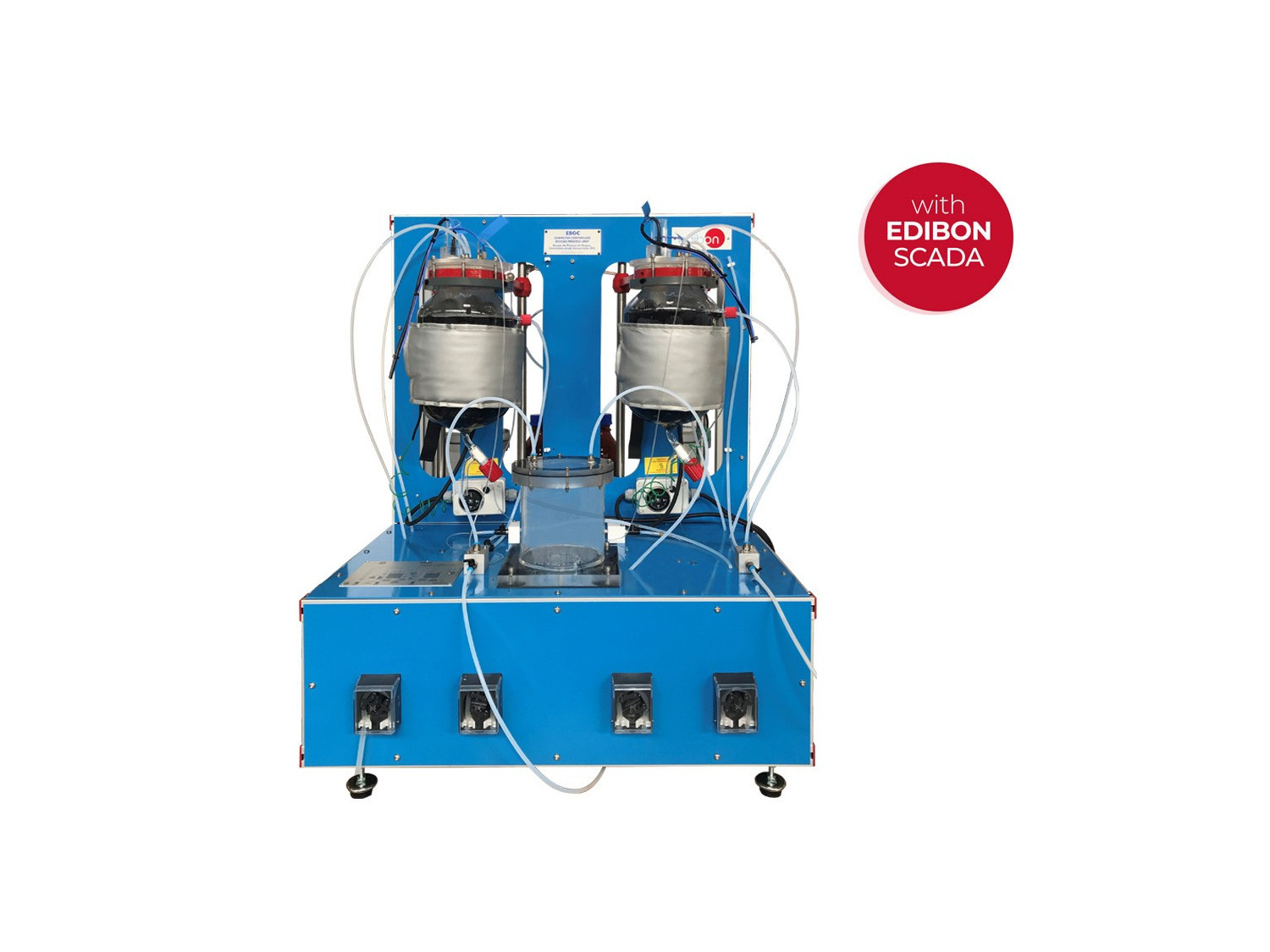 The Computer Controlled Biogas Process Unit, "EBGC", is supplied with two packed anaerobic digesters. In this way, the user can work either in only one stage or in two stages, separating the different phases of the digestion process (the processes of hydrolysis, acidogenesis and acetogenesis would take place in the first digester, and the methanogenesis in the second digester).
Both digesters have a heating blanket that allows to regulate (PID Control) both the appropriate temperature for each part of the process and the operation with different ranges depending on the used microorganisms. Thus, it can operate at the psychrophilic range (room temperature), mesophilic range (temperatures around 35ºC) or thermophilic range (temperatures around 55ºC).
The unit has four computer controlled peristaltic pumps which enable the propelling of both the supply to be introduced in the digester and the acid and the base (introduced in two vessels located at the rear side) in order to adjust and control thoroughly the pH in each stage of the process. In case of working in an anaerobic digestion in two stages, one of the pumps carries the product from one of the digesters to the other, passing through a buffer tank which collects the excess of flow from the first reactor. The control of these pumps allows to know the different flows with which the unit is working.
Two volumetric tanks are also included for the storage and volume measurement of the generated biogas. The generated biogas flows through a pipe from the upper side of the digesters to these tanks, where the biogas volume is measured by means of a water displacement.
Such tanks have two parts: the upper side is where the generated biogas is collected and the second part, smaller than the first one and located below it, is used to collect the displaced water.
Each digester has a temperature sensor and a pH sensor. Their function is to follow the whole process and study the influence of the different controlling parameters in the anaerobic digestion.
Finally, the volumetric tanks, by their upper side, enable the flowing of the collected biogas through a pipe and its passing through a methane sensor (CH4) which allows to know the methane concentration in such current and this way, the biogas quality depending on four the physical-chemical conditions under which the anaerobic digestion is developed can be determined, as well as its value as a renewable energy source.
This Computer Controlled Unit is supplied with the EDIBON Computer Control System (SCADA), and includes: The unit itself + a Control Interface Box + a Data Acquisition Board + Computer Control, Data Acquisition and Data Management Software Packages, for controlling the process and all parameters involved in the process.
COMPUTER CONTROLLED BIOMASS PROCESS UNIT
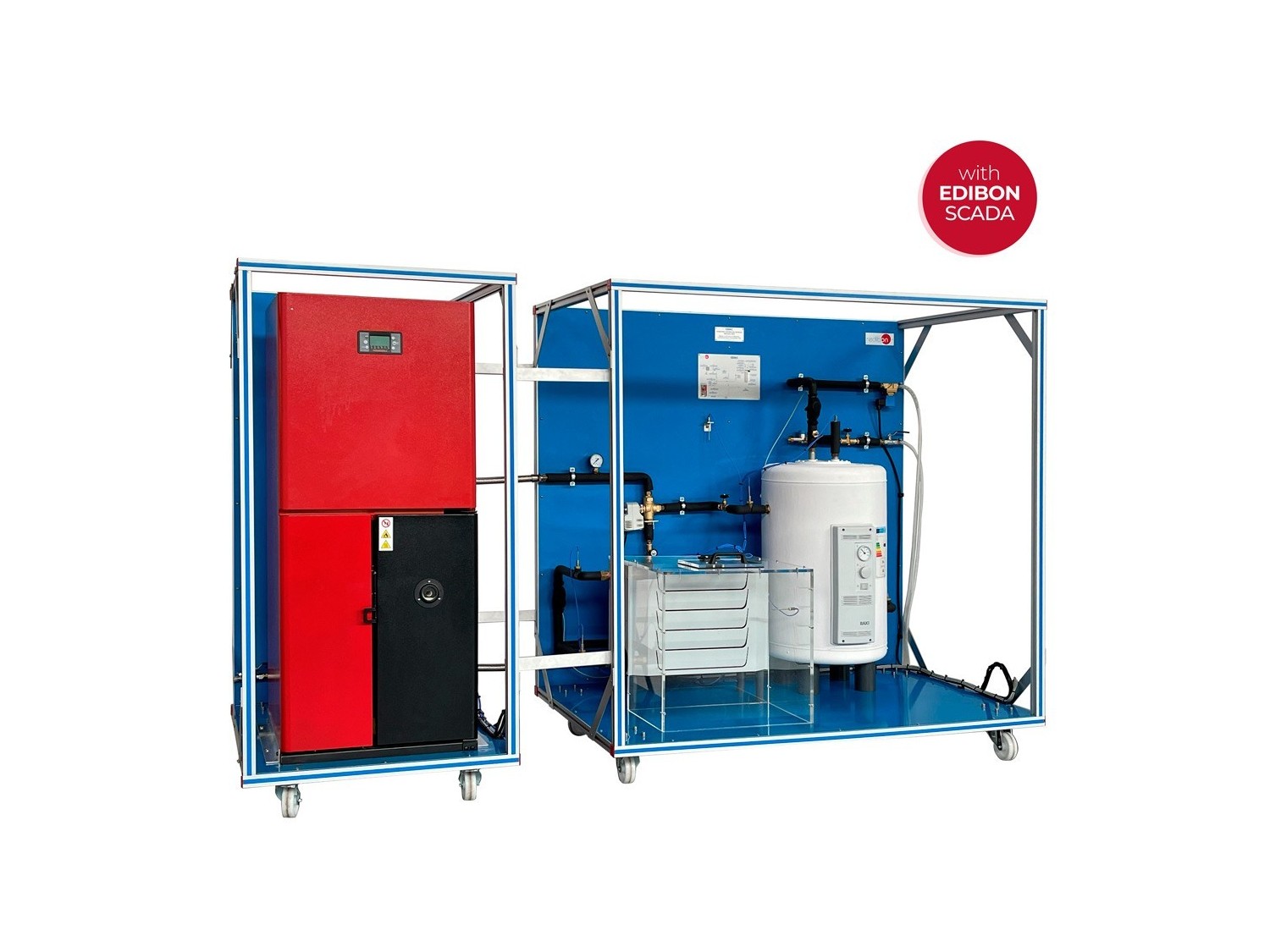 The main element of the unit is the biomass boiler, which will heat the water that will flow through the other components transferring its heat.
The boiler is a biomass boiler of 16 kW that works with pellet and other granulated fuels. The body of the boiler is made of steel with a thickness of 5 mm that guarantees a long operating life. It includes a burner made of high temperature stainless steel with self-cleaning system, which allows the use of several granulated fuels apart from Pellet.
The boiler has ashes extraction boxes, besides it facilitates the access to cleaning and maintenance areas.
The boiler heats water that is impelled by a computer controlled circulating pump through the circuit.
The unit also includes a computer controlled three-ways solenoid valve that distributes the water heated by the biomass boiler towards two primary circuits: one towards the double jacket of the storage tank to obtain domestic hot water and the other towards the unit heater to generate heating.
This valve, when activated, allows the passage of water towards both directions. On the other hand, when deactivated, it closes the water passage towards the unit heater and increases the water flow towards the hot water storage tank.
The capacity of the storage tank is 60 l and it is made of AISI 316 Ti stainless steel. This material has an excellent behavior against corrosion and high temperatures. It has a double jacket through which the water previously heated in the boiler flows, constituting the primary circuit. There is a computer controlled solenoid valve, located in the tap water inlet line towards the storage tank to be heated, that will be opened or closed according to the requirements.
The part of the unit where the heating generation is studied is formed by a computer controlled unit heater, located inside a PMMA box.
It allows the student to control the time required to heat the box up to the required temperature. The temperature control of that box is possible thanks to a PID control via software that acts on the three-ways solenoid valve.
The primary circuit is closed with the recycling of both the water from the circuit that has already given its heat in the storage tank and the water leaving the unit heater. Both lines are joined and enter the boiler again, thus closing the primary circuit.
This Computer Controlled Unit is supplied with the EDIBON Computer Control System (SCADA), and includes: The unit itself + a Control Interface Box + a Data Acquisition Board + Computer Control, Data Acquisition and Data Management Software Packages, for controlling the process and all parameters involved in the process.
COMPUTER CONTROLLED BIODIESEL PROCESS UNIT
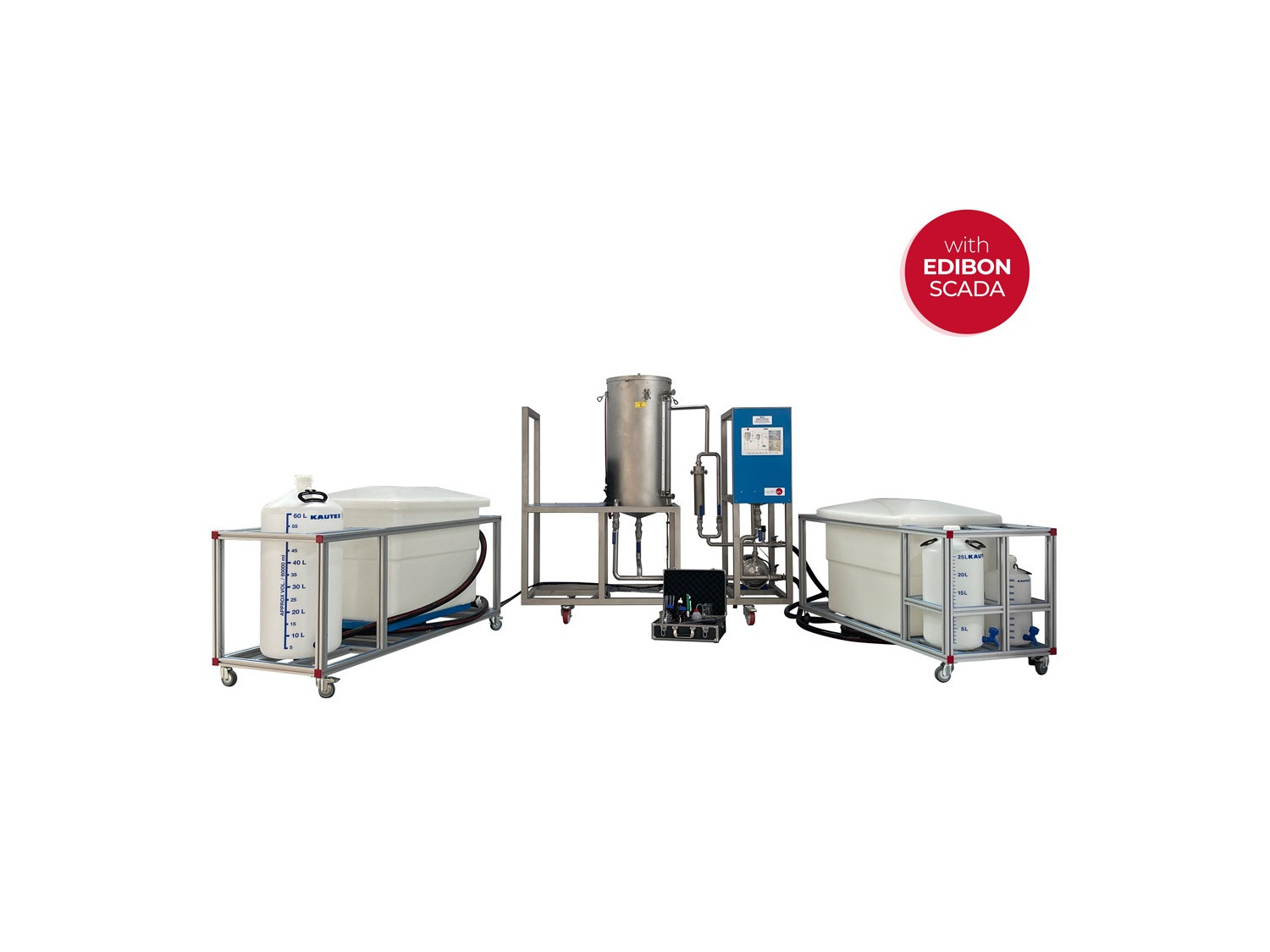 The process carried out by the Computer Controlled Biodiesel Process Unit, "EBDC", consists of the transformation of the fatty acids from vegetable oils into a biofuel of high energetic power.
The process basically consists of two well-defined stages:
- Stage I: Mixing and reaction under agitation. This first stage begins with the addition of vegetable oil to the main tank (reactor), and the preparation of the catalyst in a smaller secondary reactor. Next, reagent and catalyst are combined by subjecting the mixture to intense agitation and homogeneous heating, this is achieved by recirculating the medium through a centrifugal pump and providing heat by means of an electrical resistance, both actuators are computer controlled. This stage is carried out in a stainless steel reactor with temperature sensor and level switches that allow a controlled and safe operation.
- Stage II: Separation and washing of the obtained products. A second fundamental stage after the reaction is the separation of the main product from the rest of the by-products found in the medium. This is done by means of a first biphasic decantation. Decanting is a suitable operation when the compounds to be separated are not miscible with each other, which is the case between biodiesel and glycerin. Glycerin has a higher density than the fuel, so it is easily removed through the conical bottom of the reactor. On the other hand, the biodiesel undergoes a washing stage in which it is recirculated through a small ion exchange column that allows the elimination of impurities and water that may remain after the reaction. Finally, the fuel is passed through a diesel filter before final storage.
Additionally, the performance of the unit and the quality of the biodiesel can be evaluated thanks to a load cell installed in the product tank and a titration kit (pipette, drippers, etc.).
This Computer Controlled Unit is supplied with the EDIBON Computer Control System (SCADA), and includes: The unit itself + a Control Interface Box + a Data Acquisition Board + Computer Control, Data Acquisition and Data Management Software Packages, for controlling the process and all parameters involved in the process.